By Hassan Saliu
15th September, 2026
Abstract
As Nigeria approaches the January 2027 general elections, the capacity of opposition political parties to dislodge the ruling All Progressives Congress (APC) remains central to the country’s democratic consolidation. This paper examines the collective and individual prospects of three opposition platforms: the African Democratic Congress (ADC), the Social Democratic Party (SDP), and the National Democratic Congress (NDC). This analysis excludes the Peoples Democratic Party (PDP) because its recognised leadership faction has, to date, supported the incumbent administration at the presidential level. Anchored on the theory of party system fragmentation and elite coalition theory, this paper argues that while significant public discontent exists against the ruling party, the opposition’s fragmentation, ideological convergence, legal contestations, and candidate-centric ambitions significantly undermine its electoral viability. The paper concludes that without a credible coalition arrangement that transcends individual ambitions, the opposition is unlikely to win in 2027.
Keywords: Nigeria, Opposition Politics, 2027 Elections, Coalition, ADC, SDP, NDC, Electoral Competition.
1.0 Introduction
Nigeria operates a multi-party democratic system with 22 registered political parties according to the Independent National Electoral Commission (INEC). Only 18 of them are taking part in the 2027 presidential election. However, the party system has been characterised by weak ideological differentiation and a convergence around elite-driven, personality-based politics.
This paper examines the opposition’s chances in the 2027 presidential election, following an earlier effort on the ruling party, the APC. The analysis proceeds in two parts: first, an assessment of the opposition’s collective capacity to form a viable alternative to the APC, emphasising how fragmentation and personal ambitions create an urgent need for strategic cohesion.
2.0 Theoretical Framework: Party Fragmentation and Elite Coalitions
Two theoretical perspectives inform this analysis. First, party system fragmentation theory posits that a high number of parties with low ideological distinction leads to electoral volatility and weakens opposition forces’ capacity to aggregate interests effectively.
Second, elite coalition theory suggests that electoral victory in heterogeneous societies such as Nigeria often requires cross-regional elite alliances. The failure to coalesce around a single platform in the 2023 elections, which dispersed the anti-APC vote among the PDP, LP, and NNPP, serves as a critical reference point. The central question for 2027 is whether opposition elites can overcome the collective action problem that has historically undermined their efforts.
3.0 The Collective Landscape of the Opposition
Before the 2027 elections, opposition elements have made discernible efforts to coalesce. The most significant development was the migration of prominent political actors to the African Democratic Congress (ADC) in July, 2025. This movement was precipitated by the decision to forgo forming a new political party because of the procedural complexities of INEC registration. This challenge underscores the importance of understanding legal and structural hurdles, which can dampen enthusiasm but also motivate careful planning and resilience among stakeholders.
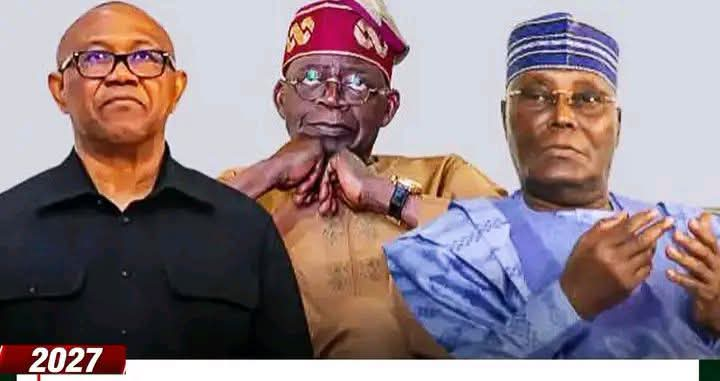
A major setback for the nascent coalition was Peter Obi’s exit, a principal figure in the 2023 elections. After negotiations stalled within the ADC, Obi explored alternative platforms, including the New Nigeria People’s Party (NNPP), and later became associated with the National Democratic Congress (NDC), a party INEC registered in February 2026 under a court directive, with pending litigation. He is currently the party’s flagbearer for the presidency, bringing the NNPP’s main structure with him. Rabiu Kwankwaso is thus the party’s vice-presidential candidate, an arrangement that they hope will bring Kano and, indeed, Northern votes for Peter Obi.
In response to this fragmentation, a civil society-driven initiative known as G100 has emerged. The G100, comprising 100 prominent Nigerians, has convened meetings to foster unity among the opposition. However, the absence of principal political actors from these deliberations raises questions about the initiative’s capacity to translate dialogue into an electoral alliance. Speculation that they may not emerge as the sole candidate in the new coalition could explain their absence.
The fundamental question therefore remains whether political actors with established presidential ambitions can subordinate individual interests to a unified candidacy. This remains unresolved.
4.0 Individual Appraisal of Key Opposition Contenders.
4.1 Atiku Abubakar and the African Democratic Congress
Alhaji Atiku Abubakar is a veteran of Nigeria’s presidential politics and has contested since 1992. His electoral history includes multiple party primaries and general elections, with notable absences in the 2003, 2011, and 2015 presidential elections.
As of 2025, he was widely reported as the frontrunner for the ADC presidential ticket, which he eventually secured. His strategic calculus appears to be focused on consolidating support in the North East and parts of the North West geopolitical zones. However, the utility of this regional base is questionable given Nigeria’s constitutional requirement that a presidential candidate secure both a plurality of votes and at least 25% in two-thirds of the states. Moreover, his former principal, Olusegun Obasanjo, has contributed negatively to his electoral outing. Meanwhile, Atiku is soldering on with his presidential ambition.
Several factors militate against his candidacy. First, his age- he will be 80 years old in 2027- has become a subject of public discourse regarding capacity and stamina for governance. Second, despite his proposal to serve a single term, scepticism persists due to his long association with the political establishment. Third, a trust deficit exists among segments of the electorate and within the opposition itself, stemming from his insistence on the presidential ticket and his historical disagreements with key political actors, a dynamic that adversely affected his 2023 campaign. Fourth, his long-running corruption allegations have also weighed on his campaign. Fifth, zoning politics may be a hard nut for him to crack.
Nevertheless, he is rumoured to be a hard nut for the APC to crack in his strongholds. He is also counting on the electoral strength of his vice-presidential candidate, Rotimi Amaechi, whom he has picked from the South-South. Watchers are waiting to see Rotimi Amaechi’s impact on the ticket because he has not shown much strength in recent elections.
4.2 Peter Obi and NDC
Mr. Peter Obi emerged as a significant political actor during the 2023 elections. After leaving the PDP for the Labour Party (LP), he mobilised a substantial youth constituency and delivered a strong electoral performance despite lacking traditional party structures.
After 2023, Obi’s political trajectory has involved realigning with the NDC following the collapse of ADC coalition talks that would have seen him flying the party’s ticket. He has positioned himself as a nationalist advocating for more production, fiscal prudence, and anti-corruption. This messaging has resonated with urban youth and certain Christian demographics. He has also secured a strong base in the South East.
Notwithstanding these strengths, Obi faces significant structural challenges. These include inadequate party infrastructure, the constraints of a relatively new political platform, and the monetised nature of Nigeria’s electoral process. Allegations also question his certificates and his actual impact as governor of Anambra State. Some critics are not impressed by his political nomadism and lack of firmness, which has divided his camp. His greatest liability remains his geographical spread, a constitutional requirement that has proven difficult for candidates with strong regional bases. Moreover, his appeal remains largely confined to social media and urban centres, with limited penetration in rural constituencies. He is, however, a man to watch as the country looks ahead to 2027, especially with his joint ticket with Rabiu Kwankwaso, a strong factor in Kano politics.
4.3 Prince Adewole Adebayo and the Social Democratic Party
Prince Adewole Adebayo is the presidential candidate of the Social Democratic Party, SDP, a position he also held in 2023. The SDP, no doubt, maintains a presence across the 36 states, though its electoral significance remains unsubstantiated.
Adebayo has stayed visible through media engagement and consistent criticism of the Tinubu administration. His campaign has shown courage and focused on economic issues, including a pledge to reduce petroleum prices. He also draws symbolic capital from the legacy of the SDP of the Third Republic. His eloquence is a strength. We will see how that translates into electoral victory in 2027. Adebayo has picked his vice-presidential candidate from the North, apparently to win more votes from the region.
However, four factors constrain his candidacy: weak party structures, inadequate campaign financing, image problem, and internal party disputes. While the SDP participated in G100 consultations, Adebayo is unlikely to emerge as a consensus candidate in any opposition coalition because of the limited electoral strength he brings to the table. He is generally seen as representing the same interest as the incumbent President of Nigeria. He has, however, denied this allegation.
5.0 Conclusion
This paper has assessed the prospects of the Nigerian opposition in the 2027 presidential election. The analysis indicates that the opposition, in its current fragmented state, lacks the structural and strategic capacity to defeat the APC, which will have been in power for 12 years by 2027. The path to electoral competitiveness lies in forming a credible coalition. However, this is impeded by eight primary factors:
First, individual ambition. Atiku Abubakar’s posture suggests an unwillingness to accept any arrangement that does not place him at the centre. His media aides have given enough indication of that. Similarly, Peter Obi has implied that 2027 may represent his final opportunity, given the prospect of a return of power to the North in 2031. These calculations make producing a common opposition candidate a herculean task.
Second, a trust deficit exists between the opposition and the electorate, a condition it shares with the ruling party. Many Nigerians doubt if opposition figures have what it takes to reset Nigeria: they are only pretending to be better than the present leadership.
Third, opposition leaders’ failure to articulate a coherent, context-specific policy alternative further weakens their appeal. One understands that this is in the works among the opposition parties.
Fourth, the ruling party’s coherence, shaped by incumbency and access to state patronage, presents a significant structural obstacle the opposition cannot currently match. Fifth, the issue of power rotation remains unresolved. The lack of consensus on zoning continues to shape elite calculations and complicates coalition negotiations over a common candidate.
Sixth, the window for candidate substitution under the law has closed except in cases of death. This legal constraint poses a significant challenge to parties engaged in coalition talks. Seventh, the Nigerian electorate is yet to demonstrate the sophistication required to execute a two-step voting pattern: voting for different parties in legislative elections, while coalescing behind a consensus presidential candidate to defeat the APC.
Eighth, the noise about a rainbow coalition vibrating across the country, championed by Nyeson Wike, is another development that portends danger for the main coalition efforts. Its inclination of voting for President Tinubu for a second term, but voting for PDP candidates in other elections could weaken the other parties working to emerge with one presidential candidate to confront the APC.
Ultimately, unless opposition actors can resolve internal legal disputes, manage personal ambitions, and present a united front, the 2027 election is likely to reproduce the pattern of 2023, in which fragmentation facilitated the incumbent party’s victory.
Hassan A. Saliu, FNPSA
Department of Political Science,
University of Ilorin.